Custom Deck Builder in Utah County
Rooval Deck & Beam Builders is a Lehi-based, licensed and insured contractor building custom cedar, redwood, and composite decks throughout Utah County, with typical projects running $18,000–$35,000 depending on size, materials, and site conditions. We handle design, permitting, and framing engineered for Utah’s frost depth and snow loads, from Lehi to Provo.
Related: interior wood beams · deck financing options · deck permits in Utah County.
Rooval Deck & Beam Builders designs and builds custom cedar, redwood, and composite decks across Utah County and the south Salt Lake Valley. We’re part of the Rooval family of companies — licensed and insured Utah builders based in Lehi — and every deck we build is engineered for Utah’s real conditions: 30-inch frost depth, 40+ psf ground snow loads, and the intense UV that comes with living at 4,500–5,500 feet.
Wondering what a deck actually costs before you talk to anyone? Start with our transparent pricing page: see real 2026 deck prices in Utah.
Cedar, redwood, or composite — which decking is right for Utah?
There’s no single right answer; there’s a right answer for your budget, your sun exposure, and how much maintenance you’ll actually do. Here’s the honest comparison we walk homeowners through:
| Material | Strengths | Trade-offs in Utah |
|---|---|---|
| Cedar | Natural look, naturally rot-resistant, cooler underfoot than composite, most affordable of the three | Needs re-staining every 2–3 years here — high-altitude UV grays cedar fast if it’s neglected |
| Redwood | Richer color and tighter grain than cedar, excellent dimensional stability, premium natural-wood option | Costs more than cedar; same UV maintenance schedule applies |
| Composite (Trex, TimberTech) | No staining or sealing, fade- and stain-warrantied by the manufacturer, best long-term value if you plan to stay put | Higher upfront cost; darker boards get hot in full south-facing sun, so color choice matters |
At our elevation, UV exposure is significantly stronger than at sea level — it’s the main reason capped composites like Trex and TimberTech have become the default for low-maintenance builds, and the main reason we’re blunt about the staining schedule if you choose wood. Both are great decks. Only one of them asks you for a weekend every couple of years. For line-item numbers on each material, see real 2026 prices on our deck cost page.
Can you build multi-level and second-story decks?
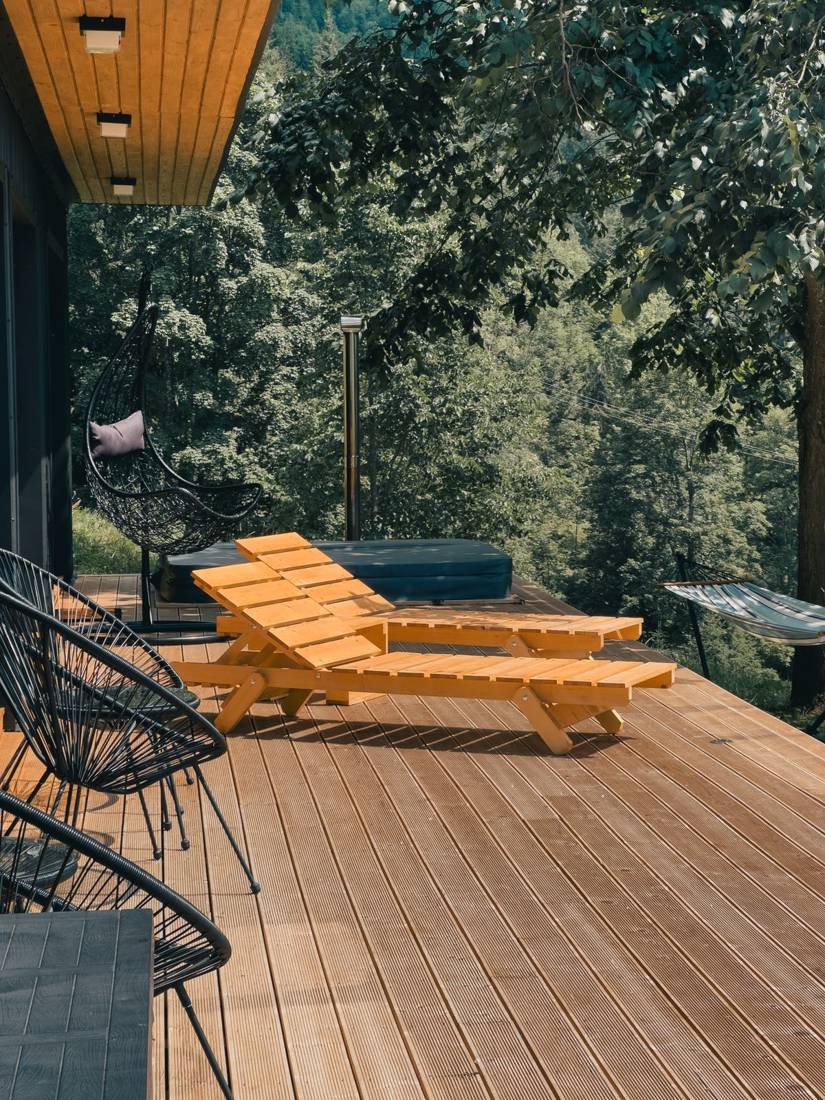
Yes — and this is where engineering matters most. Walk-out basements in places like Lehi, Saratoga Springs, and Eagle Mountain often put the main-floor door 9–10 feet above grade, which means a second-story deck is the only way to use it. We handle:
- Second-story decks off main-floor kitchens and living rooms, with properly flashed ledger attachments so water never gets behind your siding
- Multi-level designs that step down to a patio or hot-tub level, connected by wide stairs or landings
- Under-deck dry space so the patio below a second-story deck stays usable in rain and snowmelt
- Freestanding decks where attaching to the house isn’t practical or the ledger can’t carry the load
Any deck more than 30 inches above grade triggers guardrail and permit requirements in Utah — more on that below.
What railing and stair options do we offer?
- Wood railings — matched cedar or redwood, the classic look at the classic price
- Composite railing systems — Trex and TimberTech rail lines that match your decking and never need paint
- Black aluminum balusters or panels — a popular middle ground: durable, thin-profile, keeps the view
- Cable and glass rail — for mountain-view lots in Alpine and Highland where you paid for the view and don’t want pickets in front of it
- Stairs — straight runs, L-shaped with landings, and wide “party stairs” that double as seating; all built to code rise/run with graspable handrails where required
Guardrails are required at 36 inches minimum height on any deck surface more than 30 inches above grade, with baluster spacing that won’t pass a 4-inch sphere. We build to that on every deck, permitted or not.
How do we engineer decks for Utah County conditions?
This is the part most homeowners never see, and it’s the part that decides whether your deck is still solid in 25 years.
- Frost footings to ~30 inches. Utah County frost depth runs about 30 inches. Footings poured shallower than that heave when the ground freezes, which is why older decks develop that telltale lean. We dig below frost line and size footings for the actual load.
- Snow load of 40+ psf. Wasatch Front ground snow loads run roughly 30–43 psf depending on your city and elevation — well above what national span tables assume. We size joists, beams, and posts for your address, not a generic chart.
- UV-rated materials and finishes. At 4,500–5,500 feet, sun degrades cheap fasteners, plastics, and finishes fast. We spec stainless or coated hardware and finishes rated for high-UV exposure.
- 2021 IRC compliance. Utah runs the 2021 International Residential Code statewide. Ledger bolting patterns, lateral-load connectors, joist hangers, post-to-beam connections — all built to current code, not habit.
Do you handle permits and HOA approval?
Yes. In most Utah County cities, a permit is required for any deck attached to the house or any deck more than 30 inches above grade. We prepare the site plan and framing drawings, submit the permit application to your city, and schedule the inspections. If your neighborhood has an HOA — common in newer developments in Saratoga Springs, Eagle Mountain, and Lehi — we put together the drawings and material samples your architectural review committee asks for and handle the back-and-forth. You sign forms; we do the legwork.
What’s our process from first call to finished deck?
- On-site consult. We measure, look at grade, sun exposure, and access, and talk through materials and layout. Free, no pressure.
- Design and written quote. You get a drawn plan and a line-item written quote within 48 hours — not a vague “starting at” number.
- Permits and HOA. We file and track approvals before any dirt moves.
- Build. Footings, framing, decking, rails, stairs — with city inspections at footing and final.
- Walkthrough and warranty. We walk the finished deck with you and hand over your written workmanship warranty plus manufacturer warranties on composite materials.
Ready to get a real number for your deck?
What happens next:
We come to you, measure, and talk options.
Line-item pricing, in writing.
Licensed & insured Utah builders • Utah DOPL #13861046-5501 • Built by the Rooval family of companies • 5-Year Workmanship Warranty in writing
Prefer to research first? See real 2026 deck prices for Utah before you call.
Frequently asked questions
How much does a custom deck cost in Utah County?
It depends on size, material, and height — a ground-level cedar deck and a second-story composite deck with cable rail are very different projects. Rather than quote a misleading average here, we publish transparent line-item numbers: see real 2026 deck prices.
Do I need a permit for a deck in Utah County?
Usually, yes. Any deck attached to the house or more than 30 inches above grade requires a building permit in most Utah County cities, under the 2021 IRC that Utah runs statewide. We handle the drawings, submission, and inspections as part of every permitted build.
Is composite decking worth the extra cost over cedar?
If you plan to stay in the home 10+ years and don’t want to re-stain every 2–3 years, usually yes — Trex and TimberTech carry long manufacturer fade and stain warranties, and Utah’s high-altitude UV is hard on wood finishes. If upfront budget is the priority, cedar is a great deck that simply asks for maintenance.
How deep do deck footings need to be in Utah County?
Below the frost line, which is about 30 inches here. Shallower footings heave with freeze-thaw cycles and cause decks to shift and lean over time. We dig every footing below frost depth and size it for your deck’s actual load, including our 40+ psf snow-load requirement.
Do you build anything besides decks?
Yes — we also install interior wood beams (structural and decorative faux box beams) and build pergolas and outdoor structures, so a deck-plus-pergola project can be designed and quoted as one job.
Rooval Deck & Beam Builders is a DBA of Rooval LLC, sister company to Rooval Roofing. Based in Lehi, serving American Fork, Orem, Provo, Draper, Sandy, and all of Utah County. Call (801) 671-4062.