
Interior Wood Beams in Utah — Structural & Decorative
Rooval Deck & Beam Builders installs structural and decorative interior wood beams throughout Utah County, with most projects running $15,000–$25,000 depending on species, span, and whether the beam is load-bearing. We handle everything from engineered structural beams to reclaimed timber accents, backed by our 5-Year Workmanship Warranty in writing.
Serving Lehi, Provo, and Highland. Compare faux, real, or reclaimed wood beams and see our 5-Year Workmanship Warranty.
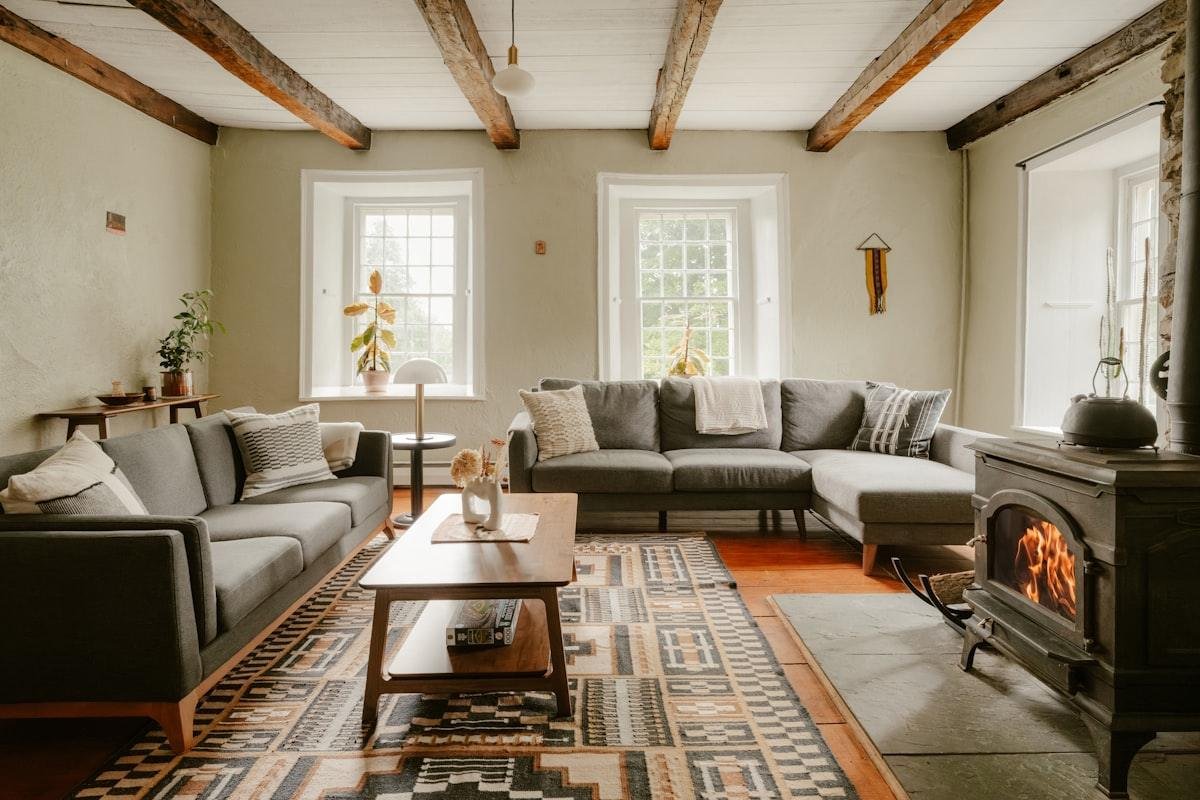
Nothing changes a room like real wood overhead. Beams pull the eye up, add depth and shadow to a flat drywall ceiling, and give a new-build home the warmth and architectural character it was missing. Whether it’s a vaulted great room in Highland, a farmhouse kitchen in Lehi, or a fireplace mantel in Provo, wood beams are the detail people notice first — and remember.
Rooval Deck & Beam Builders installs interior wood beams across Utah County and the south Salt Lake Valley — decorative faux box beams, solid and reclaimed timber, and true structural beams. That last part is our differentiator: we’re a licensed, insured Utah builder, not a trim crew. If your project involves removing a wall, opening up a vaulted ceiling, or carrying a real load, we can handle the engineering, the permit, and the installation — not just the glue-up boxes.
What’s the difference between structural, decorative, and faux box beams?
- Faux / box beams — three-sided hollow “U” boxes, built from real wood (knotty alder, cedar, fir) or high-density foam, mounted over cleats on the ceiling. Lightweight, no engineering needed, and from the floor they read as solid timber. The most popular option for kitchens, basements, and entryways.
- Solid decorative beams — real full-dimension timber (or reclaimed barn wood) mounted for looks, not load. Heavier, so mounting is engineered to the framing, but no permit is required because the beam isn’t carrying the house.
- Structural beams — beams that actually hold something up: a ridge beam in a vaulted ceiling, a flush or dropped beam replacing a load-bearing wall, exposed rafters. These require a Utah-licensed structural engineer’s stamp and a city building permit under the 2021 IRC, which Utah has adopted statewide. This is where most “beam companies” tap out — and where we don’t.
Which wood species work best for Utah homes?
Along the Wasatch Front, four species cover almost every look:
- Knotty alder — the Utah favorite. Warm tone, visible knots, stains beautifully to match alder cabinets and doors already common in Utah County homes.
- Cedar — lighter weight, straight grain, natural aroma; excellent for box beams and vaulted ceilings where weight matters.
- Douglas fir — the classic structural timber. Strong, tight-grained, and the default choice when a beam is doing real work.
- Reclaimed timber — genuine age, saw marks, checking, and patina you can’t fake. We source reclaimed barn wood and vintage timbers through Salt Lake–area suppliers, so you don’t have to hunt it down yourself.
Where do wood beams make the biggest impact?
A few rooms get the most out of beams. If you’re still deciding on a look, browse our interior wood beam ideas for Utah homes.
- Vaulted great rooms — a ridge beam with rafters or a simple 2–3 beam layout turns tall empty drywall into the centerpiece of the house.
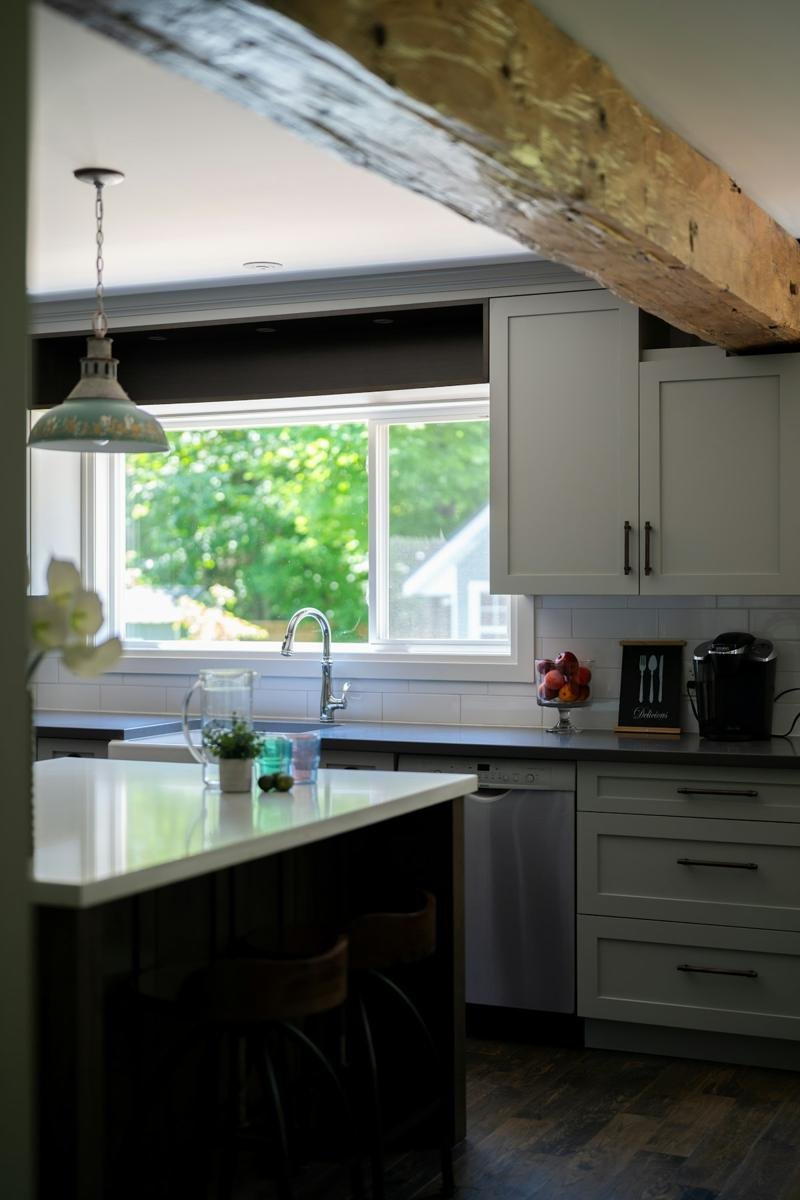
- Kitchens — beams over an island define the space and add farmhouse or mountain-modern character without a remodel.
- Fireplaces & mantels — a solid or reclaimed timber mantel is the fastest single upgrade in this category, often installed in a day.
- Basements — box beams wrap steel I-beams and ductwork soffits so a finished basement stops looking like a basement.
- Entryways — a beamed entry ceiling or header sets the tone the moment the front door opens.
How we decide between mitered corners and simpler joinery
If you will see the corner up close, we miter it. If the beam runs high on a vaulted ceiling where nobody will ever stand next to it, we use simpler joinery and put the labor into the parts you actually look at. That is the whole rule, and it is worth explaining, because the corner is where a box beam gives itself away.
A mitered corner brings both faces together at a single continuous edge, so there is no seam line running the length of the beam. Butting one board against the face of the other leaves a sawn edge sitting in a different plane. Once afternoon light rakes across the ceiling, that line reads from the far side of the room.
Mitering is not the only professional way to build a beam, and we will not pretend otherwise. On 16- to 24-foot runs across a vaulted ceiling, experienced finish carpenters often choose a deliberate offset at the corner instead, because a miter that long has to be closed in the air at height — and a miter that does not quite close looks far worse than an offset that was intended from the start. Both are legitimate work. The deciding factors are viewing distance and whether the joint gets closed on a bench or on a ladder.
What separates a well-built box beam from a cheap one
- Glue squeeze-out showing under stain. Squeeze-out is nearly invisible on bare wood. It appears after staining, because dried glue seals the pores and blocks the stain, leaving pale streaks along the joint. It is the clearest tell there is.
- Whether the corner was burnished or filled. Burnishing closes a hairline corner using the wood’s own fibers. Filler is the fallback, and it telegraphs under stain.
- Whether the miters actually close. A gapped corner is a saw-calibration problem, not a lumber problem.
- Scribed to the ceiling, or caulked to it. Ceilings are not flat. A scribed beam follows the plane it is actually meeting; a caulk line hides the gap until seasonal movement opens it back up.
- What it is anchored to. Blocking screwed into joists, or toggles where the run parallels the framing. Not drywall anchors.
Ask whoever quotes your beams which of these they do. The answers will tell you more than the price does.
How much do interior wood beams cost in Utah?
Interior beam work is priced per job — because cost depends on whether the beam is decorative or structural, its span, the wood species, and your ceiling, we quote every beam in writing after a free on-site look, not by the foot. As a guide, larger structural or whole-room beam projects typically run $15,000–$25,000, while a single decorative beam is a much smaller job. A structural beam that carries load also adds an engineer’s stamp and a city permit; a purely decorative beam needs neither.
Structural pricing varies widely because it depends on span, load, temporary shoring, and whether the beam is flush (hidden in the ceiling) or dropped and exposed. We give you a written, itemized quote before any work starts. For a full breakdown of what drives beam cost up or down, see our ceiling beam installation cost guide.
Why hire a licensed builder instead of a decor installer?
Most beam companies only sell the decorative product. That’s fine until your project touches structure — and in Utah it often does. Removing a load-bearing wall between a kitchen and living room, vaulting a flat ceiling, or exposing a ridge beam all change how your roof loads travel to the foundation. Along the Wasatch Front, ground snow loads run roughly 40+ psf (30–43 psf depending on city and elevation), so an undersized beam isn’t a cosmetic mistake — it’s a sagging ridge line two winters from now.
As a licensed and insured Utah builder, Rooval Deck & Beam Builders handles the whole chain: structural engineer, city permit, temporary shoring, beam installation, inspection, and the finish carpentry that makes it look like the house was built that way. And because a large share of our beam work is decorative, the finished product gets furniture-grade attention — tight scribes to textured ceilings, hidden fasteners, hand-distressing and stain matching. Every job comes with our written workmanship warranty, backed by the Rooval family of companies (our sister company is Rooval Roofing).
We’re based in Lehi and work throughout the county — see our local pages for Lehi, American Fork, and Provo.
Ready to see beams in your space?
Book a free in-home beam design consult. We’ll measure your ceiling, talk species and finish, show you layout options, and tell you honestly whether your idea is decorative or structural — and what each path costs.
Prefer to talk? Call (801) 671-4062 or email roovaldeckbuilders@gmail.com.
Licensed & insured Utah builders • Utah DOPL #13861046-5501 • Built by the Rooval family of companies • 5-Year Workmanship Warranty in writing
What happens next
- Call or send the form — tell us the room and the look you’re after.
- Free on-site measurement & design consult at your home.
- Written, itemized quote within 48 hours.
Interior wood beam FAQs
- Do I need a permit for wood beams in Utah?
- Not for decorative or faux box beams — they’re treated like trim. Structural beams (anything carrying load, like a ridge beam or a beam replacing a load-bearing wall) require an engineer’s stamped design and a city building permit under the 2021 IRC. We manage both for you.
- Can you tell if my wall is load-bearing?
- Usually yes, during the free consult — we check framing direction, what’s above the wall, and how loads stack. If it’s load-bearing, we bring in a structural engineer to size the replacement beam before quoting the work.
- Will faux box beams look fake?
- Real-wood box beams built from knotty alder, cedar, or fir are indistinguishable from solid timber from the floor — the miters are glued and the corners eased or distressed. Foam beams are cheaper and lighter but read as faux up close, so we typically recommend them only for very tall ceilings.
- Can you match beams to my existing cabinets or floors?
- Yes. We do custom stain matching on-site — knotty alder in particular takes stain very close to the alder cabinetry common in Utah County homes. We bring sample blocks to the consult so you approve the finish before installation.
- How long does installation take?
- A mantel or a few box beams in a kitchen is typically one day. A vaulted great room with multiple decorative beams runs 1–3 days. Structural projects vary with engineering and permit timelines — commonly 2–6 weeks start to finish, with the on-site work itself taking 2–5 days.
About the builder
Matthew Thompson owns Rooval Deck & Beam Builders, a DBA of Rooval LLC, based in Lehi and serving Utah County. He is licensed as a Utah general building contractor (DOPL license #13861046-5501). Rooval builds custom decks, interior wood beams, and pergolas.