The Rooval Build Standard
Every deck and beam project we build in Utah County and the south Salt Lake Valley is held to the same written spec sheet. This page is that spec sheet. Rooval Deck & Beam Builders is part of the Rooval family of companies (sister company to Rooval Roofing), and we’re licensed and insured Utah builders backing every job with a written workmanship warranty.
Why do decks fail at the ledger — and how do we flash ours?
The ledger board — where an attached deck bolts to the house — is where most catastrophic deck failures start. Water gets behind an unflashed ledger, rots the rim joist, and the connection lets go. Our standard on every attached deck:
- Siding removed at the ledger, never bolted over it.
- Self-adhering flashing membrane tucked behind the weather barrier, plus metal cap flashing with a drip edge over the ledger top.
- Structural lag screws or LedgerLOK-style structural screws into the house rim joist per the 2021 IRC fastening schedule (R507.9) — never nails alone.
How deep do our footings go in Utah soil?
Utah County’s frost depth is roughly 30 inches. Footings poured shallower than that heave every freeze-thaw cycle, which is why older decks go wavy and pull away from railings. We excavate below frost depth — typically 30 to 36 inches — and pour concrete footings sized to the tributary load and soil bearing capacity, with post bases that lift the wood post off the concrete so it can’t wick moisture.
How do we size joists for Utah snow loads?
Many national span charts assume a 40 psf live load. Along the Wasatch Front, ground snow load runs roughly 30–43 psf depending on city and elevation — a bench-side deck in Draper or Alpine carries a real winter load, and our valley sits at 4,500–5,500 feet. Our standard:
Framing spec: joists sized from IRC span tables at the governing snow load for the site, not the generic minimum; 16" on-center spacing standard, tightened to 12" on-center for diagonal decking or heavier composite boards; doubled rim joists and mechanical joist hangers at every connection.
What fasteners and moisture protection do we use?
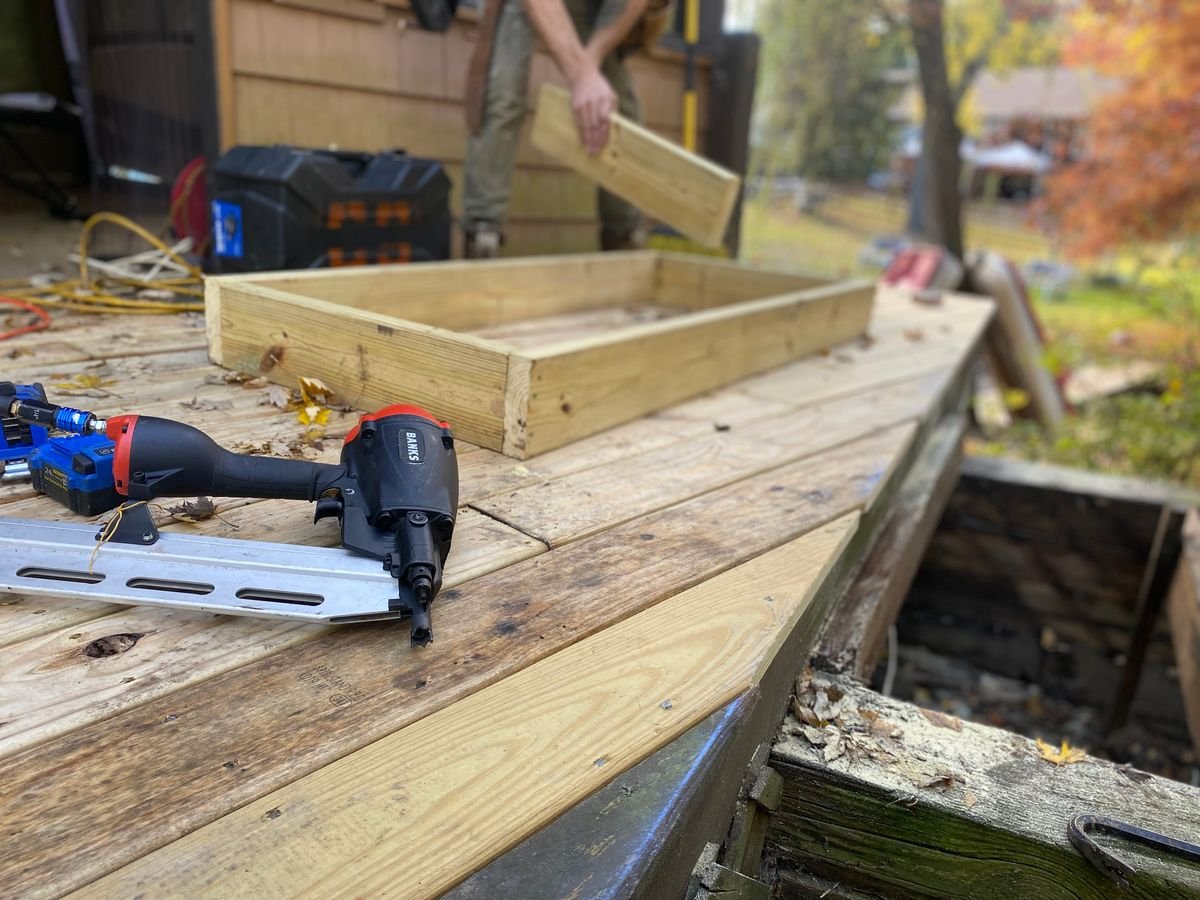
Modern pressure-treated lumber is corrosive to ordinary zinc hardware. We use hot-dip galvanized or stainless-steel fasteners, hangers, and connectors throughout, and we apply butyl joist tape to the tops of joists and beams before decking goes down. Joist tape seals every screw penetration — the single cheapest thing a builder can do to add years to a deck frame under Utah’s high-altitude UV and snowmelt cycles.
What makes a railing actually code-compliant?
- Guards required on any deck surface more than 30 inches above grade.
- Minimum 36-inch guard height, with balusters spaced so a 4-inch sphere cannot pass through.
- Guard posts blocked and through-bolted to resist a 200-pound concentrated load — not just screwed to the rim.
- Graspable handrail on stairs with four or more risers.
How do we install structural vs. decorative interior beams?
These are two different jobs, and we treat them that way on our interior wood beam service:
Structural beams (carrying floor or roof load, or replacing a wall) get an engineered LVL or glulam sized by a licensed engineer, proper point-load pathing down to the foundation, and a building permit — every time.
Decorative box beams are three-sided hollow boxes built from kiln-dried lumber, mounted to solid blocking that’s lagged into ceiling joists. They add character, not load, and typically don’t require a permit — which keeps the cost and timeline down.
Do you pull permits?
Yes — on every qualifying job. Under Utah’s statewide 2021 IRC, attached decks and any deck more than 30 inches above grade generally require a permit, and structural beam work always does. We handle the drawings, submittal, and inspections. A permit and an inspector’s signature are part of what you’re paying for; see how that fits into total pricing on our Utah deck cost guide.
Want your deck built to this standard?
We build custom cedar, redwood, and composite decks plus pergolas and outdoor structures across Utah County and the south Salt Lake Valley, from our home base in Lehi.
(801) 671-4062 | roovaldeckbuilders@gmail.com
Licensed & insured Utah builders • Utah DOPL #13861046-5501 • Built by the Rooval family of companies • 5-Year Workmanship Warranty in writing
What happens next
- Call or send the form below.
- Free on-site measurement & design consult.
- Written quote within 48 hours.
Frequently asked questions
Do I need a permit for a deck in Utah?
Usually, yes. Under the 2021 IRC adopted statewide, attached decks and decks more than 30 inches above grade typically require a building permit. Rooval Deck & Beam Builders pulls the permit and schedules inspections on every qualifying job.
How deep do deck footings need to be in Utah County?
Below the local frost depth, which is roughly 30 inches in Utah County. We typically pour footings 30–36 inches deep so freeze-thaw cycles can’t heave the deck.
What’s the difference between a structural beam and a decorative box beam?
A structural beam carries load and requires an engineered LVL or glulam, a licensed engineer’s sizing, and a permit. A decorative box beam is a hollow three-sided wood wrap mounted to blocking — it adds the look without the load, engineering, or permit.
About the builder
Matthew Thompson owns Rooval Deck & Beam Builders, a DBA of Rooval LLC, based in Lehi and serving Utah County. He is licensed as a Utah general building contractor (DOPL license #13861046-5501). Rooval builds custom decks, interior wood beams, and pergolas.